
SEO can be a powerful engine for acquiring quality leads for your agency. This guide digs into the keyword and content strategies you need to adopt to excel at SEO for agencies.
How does your agency approach new business development?
If you’re like most agencies, your top channels are probably going to be “referrals”, “word of mouth”, and “events”. Unless SEO forms a core part of your offering, it will likely rank near the bottom of the list.
Part of the reason for the general agency apathy towards SEO is its complexity and competitiveness. You aren’t just competing against other agencies; you’re fighting against AdAge, CMO.com, and a gazillion other publications.
But when done right, SEO has the potential to unlock massive value. It can bring systemic rigor to your lead generation process, and it can bring you predictable traffic month after month.
I’ll show you how you can turn organic search into a channel for new business in this guide on SEO for agencies.

Change Your Keyword Strategy
One of the biggest SEO mistakes agencies make is approaching keywords like a consumer-facing brand. That is, they focus on high-volume, untargeted keywords with little to no buying intent.
This approach puts you directly in competition with large publications. You might be able to create the best-possible page for a competitive keyword, but chances are, Inc and Forbes.com will beat you on sheer domain authority.
Just look at the competition for a broad, top-level keyword such as “content marketing services” (the highlighted scores are Moz Domain Authority (DA) scores).
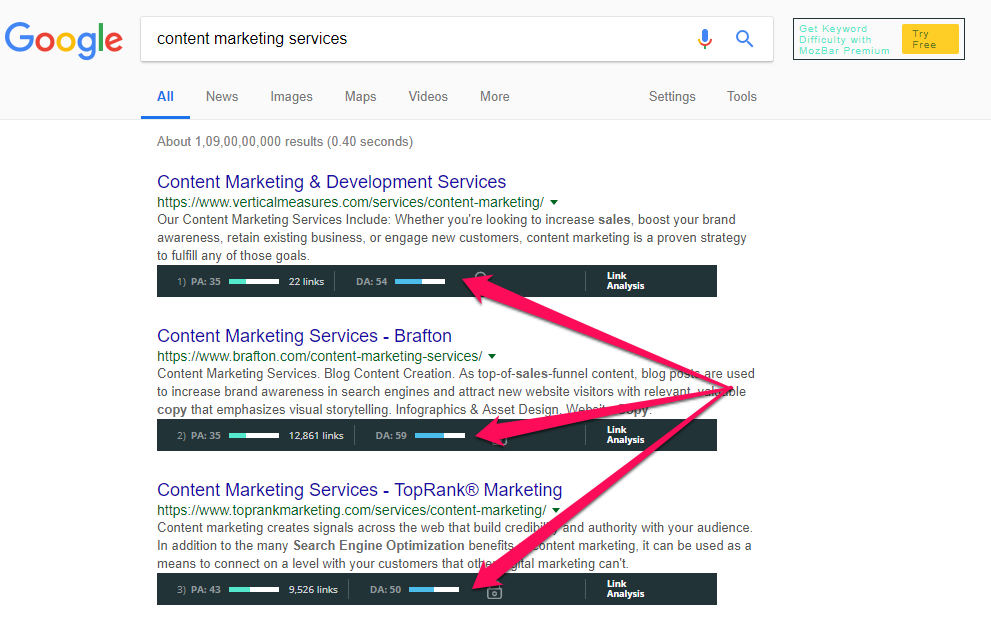
There’s also the fact that broad keywords equal untargeted traffic. You don’t know whether someone searching for “content marketing” is a fellow marketer or a potential client. You’ll have to put in extra effort to qualify any leads captured this way.
A much better strategy is to focus on long-tail keywords that either show buying intent or offer data about the user.
In other words, don’t think in terms of keywords and search volumes; think in terms of user intent.
You can divide such keywords into the following categories:
- Specific service-focused keywords: Think of keywords such as “content marketing services for SaaS”. These keywords a) describe a targeted service, and b) focus on a specific audience. While these will get little traffic, any leads you capture will be relevant.
- Competitor-focused comparison keywords: Think of keywords that compare two competitors such as “[your agency] vs [competitor’s agency]” or “[competitor’s agency] alternatives”. If these keywords include specific services (such as “[your agency] vs [competitor’s agency] content marketing”), then even better.
- Information-rich keywords: These are long-tail keywords that include a lot of information about the searcher. Think of keywords like “how to brand a SaaS startup”. Given the specific nature of such keywords, you can create highly targeted offers.
- Pre-decision keywords: These are keywords a client might search for right before making a decision to pursue an agency service. Think of keywords like “content marketing services cost” or “how to choose a content marketing agency”. Anyone searching for such keywords has shown an intent to buy and would make a good lead.
Your goal should be to intercept the client in the consideration or decision stage of the buyer journey. Barring that, target keywords that give you ample information about the searcher.
For example, as you narrow down your keyword focus from “content marketing” to “content marketing for lawyers”, both the search volume and keyword difficulty drops.
While this will impact how much traffic you get, long-tail, information-rich keywords will also give you more targeted leads.

How to Create a Targeted Keyword List
The question is: how do you put this keyword strategy into practice?
I’ll share a step-by-step process for doing so below.
1. Make a list of your services and target market
Start by making a list of all the services you offer (content marketing, SEO, etc.). Then make another list of all the potential markets you serve (law firms, startups, dentists, etc.).
Now combine the two lists to come up with a list of [service] + [target market] keywords, like this:
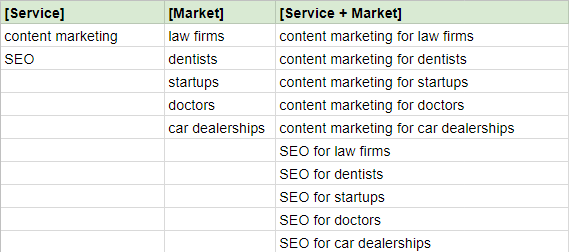
If you’re targeting a local market, add local keywords into the mix as well (such as “content marketing in Austin” and “content marketing for law firms in Austin”).
Not all these keywords will have substantial search volume, but creating landing pages for them can send a steady trickle of highly qualified leads your way.
2. Ask questions related to the purchase process
What questions do your clients ask as they go about searching for an agency? Do they look for competitors and prices? Or do they attempt to learn how the service can benefit them?
Ideally, you should have on-site surveys to answer visitors these questions, but that’s not always possible.
An alternative is to use a tool like AnswerThePublic. Enter a service-focused keyword (such as “content marketing”) and it will show a list of questions people ask related to it.
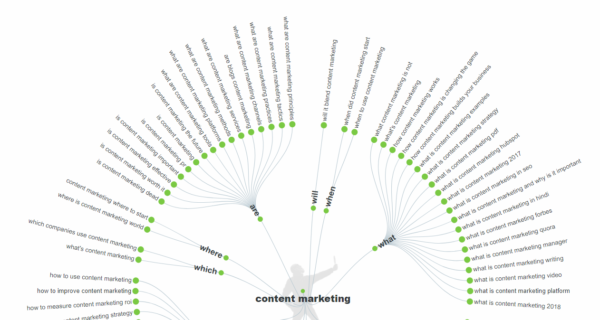
Filter out top-of-the-funnel questions (such as “what is content marketing”). Instead, focus on questions that ask about:
- Value: Questions such as “is content marketing worth it?” show that the searcher is already interested in a service, but isn’t sure if it will be worth his time or money. Intercepting users at this stage can convince them to choose your agency.
- Process: Process questions usually start with ‘how’ (such as “how to start content marketing”) shows that users are ready to start, but unsure of the process. Though they’re one step removed from the buying process, they can make for valuable leads.
Questions such as these can give you a plethora of information-dense keywords.
3. Make a list of competitors, categories, and use cases
Your next set of keywords should come from three sources:
- Alternatives and comparisons to competitors (both other agencies and software tools)
- “Best of” listings for individual categories (such as “best content marketing services”)
- Use cases and examples for different services (such as “content marketing case studies”)
Start by making a list of competitors and categories you compete in. Generate keywords from them like this:
- Alternatives to [competitor], such as “alternatives to Hubspot”
- Your agency vs [competitor], such as “Marketo vs HubSpot”
- Best [service category], such as “best content marketing service”
- Best [service category] in [local category], such as “best content marketing service in Austin”
For use-case keywords, add the words “examples” and “case studies” to your service keywords (such as “content marketing case studies”).
This approach should yield a number of highly targeted but low competition keywords. Prioritize these in your SEO strategy so you can get actual leads, and not just traffic.

Adopt an SEO-First Content Strategy
Content is usually the biggest point of failure when it comes to agency SEO. Agencies often create content that is either too broad or too sparse to be valuable to readers (and hence, search engines). If you’ve ever watched a piece of content languish at the bottom of page #10, you know exactly what this feels like.
The solution to this problem is to adopt an SEO-first content strategy. While you should certainly create content that your readers want to read (case studies, thought pieces, etc.), your content efforts should be largely guided by your SEO goals.
How? I’ll share a few practical solutions below.
Prioritize Creating Keyword-focused Landing Pages
The first step in your content strategy should be to cover all the targeted keywords you covered earlier. This is easier than you think; a template for one keyword can be reused for another. Related keywords such as “content marketing services” and “content marketing for law firms” can also share content elements.
When creating these pages, focus on two things:
- What the user wants to see on the page, as indicated by the search query
- What you want the user to do, i.e. your conversion goal
Structure your content in such a way that it leads from the user intent to your conversion goal in a natural path. For most keywords, the following structure works well:
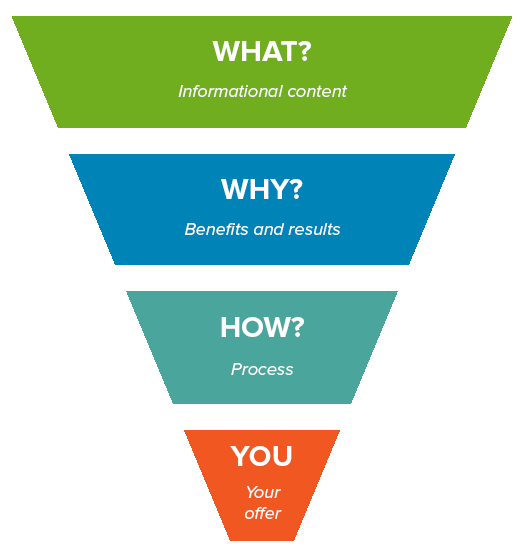
For low-information users (i.e. the query indicates they don’t understand the topic particularly well), focus more on sharing information than selling your services. For high-information users (mostly queries with late-stage keywords), emphasize selling over sharing.
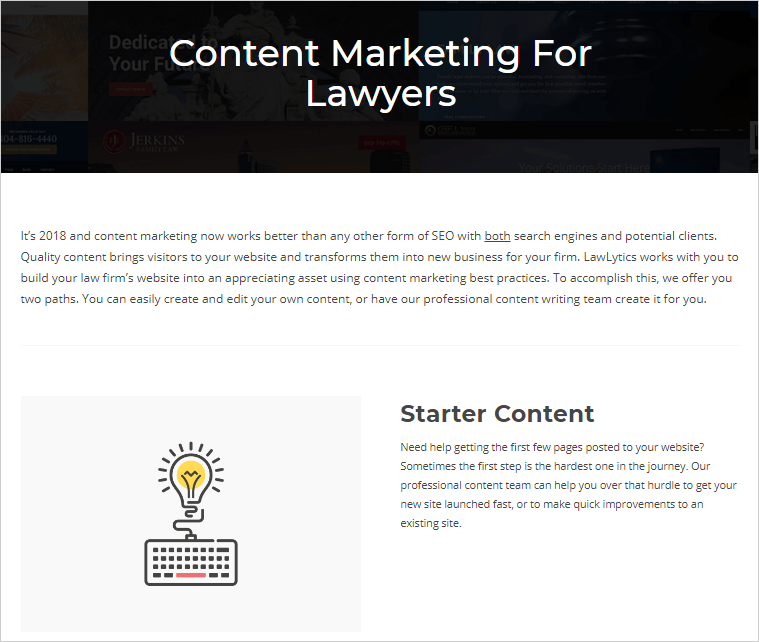
For example, this page by Lawlytics targets high-information users. Instead of explaining how content marketing works, it focuses on selling its services.
As for length, it’s always good to aim for a minimum of 1,000 words. There is a strong correlation between word count and rankings.
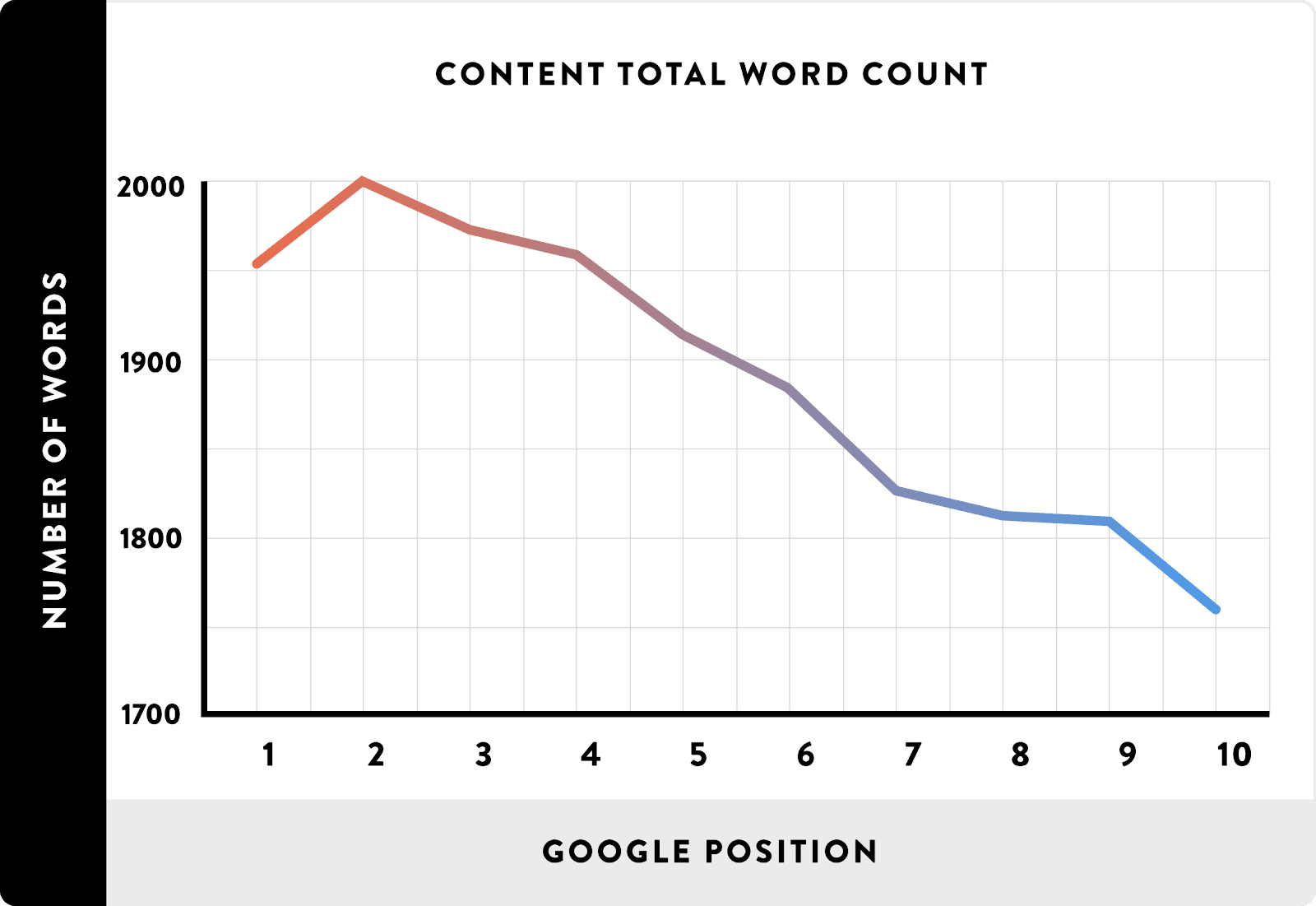
One tactic I use is to average the total word count of all the top 10 pages for the query, then add 300-500 additional words.
This should give you a ballpark figure for the word count to target for each page.
Create Content that Attracts Links Organically
Check out this page with a list of marketing statistics (Page A). Even though it’s nothing much in terms of content, it has attracted links from over 6,430 domains:

Now check out this page from Superdrug.com called ‘Perceptions of Perfection’ (Page B). Nearly 800 domains have linked to it, including the likes of Buzzfeed and HuffPo.

Both these pages have a lot of links but their approach to acquiring them is very different:
- Page A acquired linked passively through other marketers and content creators using it as a reference source.
- Page B acquired links actively by promoting it to editors at top publications.
This broadly describes the two approaches to creating content that gets links.
1. Passive approach
With the passive approach, your goal is to:
- Find keywords that content creators search for and link to
- Rank for those keywords and become a reference for other content creators
Usually, these are broad keywords that people search for to find sources for a topic. Think of “statistics” keywords, or keywords that explain a topic in-depth.
Other content creators will often link to the top ranking page on these topics (which is why Wikipedia pages often have so many links). If you can rank for such keywords, you’ll see a steady stream of links passively as people link to your page as a source.
To come up with content ideas for the passive approach, think of keywords such as:
- “What is” keywords that explain a broad topic in-depth (such as “what is SEO”)
- “Statistics” and “facts” keywords (such as “marketing statistics” and “whale facts”)
- “How to” keywords for broad topics (such as “how to get backlinks”)
A downside is that such keywords are usually extremely competitive. You can improve your chances of ranking by focusing on more long-tail keywords (such as “marketing automation statistics” over “marketing statistics”).
2. Active approach
The active approach is much harder to pull off, but it can work for any site, regardless of its existing authority. The rough process is as follows:
- Brainstorm a content idea that editors in a niche would like to link to
- Create content based on this idea
- Pitch this content to editors with a PR blitz
The most important part of this process is the content idea. You have to create something that people want to link to.
Usually, this content is:
- Highly visual
- Provocative or controversial
- Challenges established notions
- Original research or data
- Useful tool
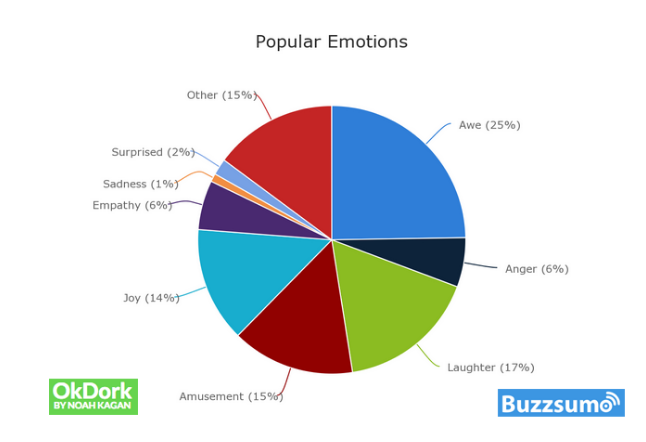
Research by Buzzsumo suggests that content that makes you laugh or evokes awe is more likely to get shared.
Original research is an easy way to get into top publications, especially if you can promise them an exclusive.
An easy way to brainstorm such content ideas is to see what top publications like Buzzfeed have shared in the past. If you can create something similar to content that was successful in the past, editors are likely to run it again.
For example, the Perceptions of Perfection infographic by Superdrug was inspired by this project by artist Esther Honig.
Another tactic is to explore heavily shared infographics. To find such content, head over to Buzzsumo and look up a target publication’s domain. If you’re looking only for visual content, make sure to check “infographics” under ‘Content-Type’ in the filters.

This will show you what kind of content editors at your target publications like to share. Use it to brainstorm content ideas.
Creating content is only half the journey, of course. You still have to promote it to editors. Unfortunately, this is outside the purview of this article, but here’s a guide to help you get started.
Create Targeted Links
Acquiring links passively or through shareable content isn’t to win the SEO battle. You also need targeted links to both your homepage and interior pages.
There are a lots of tactics you can try to earn these links, but the following have a high success rate:
- Guest blogging: Guest blogging remains one of the most popular link building tactics simply because it is highly targeted and has a proven success rate. Quality websites also have a high barrier to entry that keeps low-tier competitors out. Instead of linking to interior pages, use guest blogging to build brandable homepage links.
- Resource page links: These are links from collections of websites, articles, or resources. You can find them by using queries like “[your niche] + intitle:resources”. Once you have a handful of resource pages, contact each site’s owner and ask to include your resource or website in their list.
- Press queries: You can get links from high-value targets by responding to press queries posted on HARO. HARO will send out a list of queries from journalists twice a day. A well-reasoned article from an authoritative source will often get published. We used this tactic to get links like this.
- Weekly roundups: If you have compelling content, you can often get placed in weekly roundups or link dumps. Find these roundups with queries like “[your niche] + ‘intitle:[link dump/weekly list/roundup]”.
There are other tactics as well, such as getting featured in podcasts or landing interviews, but that’s less about SEO and more about PR. For most agencies, a combination of passive & active content with targeted link building will yield great results.
Over to You
SEO for agencies can be complicated. You’re often competing against publications with substantially more domain authority and resources than you. The first step in winning this battle is to pick the right keywords. Targeted low-volume keywords can bring you quality leads, especially when paired with detailed content.
Combine this with a pragmatic link building approach and you can easily turn SEO into a powerful channel for new business.
What does your agency’s SEO strategy look like? Share with us in the comments below!

About the Author